
The United Nations Office at Geneva
Multimedia Newsroom
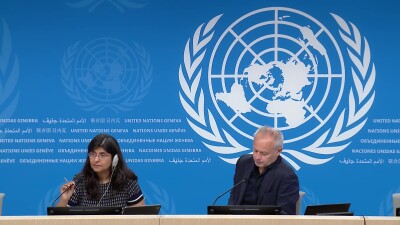
Rolando Gómez, Chief of the Press and External Relations Section at the United Nations Information Service (UNIS) in Geneva, chaired the hybrid briefing, which was attended by spokespersons and representatives from the UN Refugee Agency, the Office of the United Nations High Commissioner for Human Rights and the World Health Organization.
Largest Influx of Rohingya Refugees in Bangladesh since 2017
Babar Baloch, for the UN Refugee Agency (UNHCR), said the Agency and humanitarian partners were mobilizing to respond to the needs of 150,000 Rohingya refugees who had arrived in Cox’s Bazar in Bangladesh over the last 18 months due to targeted violence and persecution in Rakhine State and the ongoing conflict in Myanmar. This movement of Rohingya refugees into Bangladesh was the largest from Myanmar since 2017, when some 750,000 had fled violence in their native Rakhine State.
Bangladesh had generously hosted Rohingya refugees for generations. In Cox’s Bazar, these new arrivals joined another nearly one million Rohingya refugees crammed into a 24-square kilometres space. Among the new arrivals, 121,000 had been identified by the end of June, with more believed to be residing informally in the already overcrowded refugee camps. The overwhelming majority were women and children.
More humanitarian support was urgently required as the new arrivals were dependent on the solidarity of those living in the camps. Biometric identification had allowed humanitarian partners in Bangladesh to provide the new arrivals with basic services, including food, medical care, education and essential relief items. However, this would soon dry up without an immediate injection of funds. Unless additional funds were secured, health services would be severely disrupted by September and essential cooking fuel (LPG) run out. By December, food assistance would stop. Education for some 230,000 children was also at risk of being discontinued.
The border between Bangladesh and Myanmar remained officially closed and under surveillance by Border Guard Bangladesh. UNHCR and humanitarian partners were grateful that the Government of Bangladesh had authorized newly arrived Rohingya refugees to access emergency assistance and key services in the camps in Cox’s Bazar. As the conflict in Myanmar continued unabated, UNHCR was advocating with the Bangladeshi authorities to provide managed access to safety and asylum for civilians fleeing the conflict.
Answering questions from journalists, Mr. Baloch further explained that 255 million USD were needed to support more than one million Rohingya refugees who were already in the camps in Cox's Bazar. However, that appeal has only been 35 per cent funded: this gap would affect Rohingya refugees as they depended on humanitarian support, from food to health services and education.
With the conflict intensifying inside the Rakhine State in Myanmar, the humanitarian situation remained dire. The closest option for safety for the Rohingya was in Bangladesh. Some 619,000 Rohingya were still inside Myanmar.
Mr. Gómez referred to a recent oral update by Tom Andrews, Special Rapporteur on the human rights situation in Myanmar, in which the UN expert had outlined the factors which had led to the recent displacements and, indeed, those having taken place since 2017.
Intensification of Violence in Haiti
Ravina Shamdasani, for the Office of the United Nations High Commissioner for Human Rights (OHCHR), reported on escalating violence in Haiti: outside of Port-au-Prince, where the presence of the state was extremely limited, gang violence had claimed over 1000 lives and forced hundreds of thousands to flee since October 2024.
The mass killing in the lower Artibonite region of Haiti in October 2024 had marked a major turning point in the cycle of violence between gangs and the so-called self-defense groups. Several other mass killings followed, causing mass displacement, including in the town of Mirebalais in the Département central. This expansion of gang territorial control posed a major risk of spreading violence and increasing transnational trafficking in arms and people. Between the 1 October 2024 and the 30 June this year, the total number of killings across Haiti was 4,864. OHCHR and the UN Integrated Office in Haiti had issued a report today, along with details the evolution of violent gang incidents since October 2020 for up to June 2025.
Human rights abuses by self-defense groups had also increased; summary executions involving Haitian security forces had been committed against individuals accused of supporting gangs. OHCHR called on the Haitian authorities to ensure police had the necessary resources to tackle the gangs. Specialized judicial units were needed to combat corruption and mass crimes, including sexual violence.
The human rights violations were further evidence of why Haiti and the international community urgently needed to step up to end this violence. It was crucial that the international community strengthened its support to the authorities as well as the multinational support mission in Haiti (or Bureau intégré des Nations Unies en Haïti, BINUH). The full implementation of the arms embargo would be equally essential to restore security and the rule of law in Haiti.
Taking questions from journalists, Ms. Shamdasani said that from 1 January to 30 June 2025, at least three thousand people had been killed across Haiti, not counting the number of people injured, abducted, subjected to sexual violence, or displaced. It was not appropriate to return people to Haiti at this time, said Ms. Shamdasani, answering a question regarding the lifting, by the United States, of the protected status for Haitians.
The BINUH did not have the resources that it needed – in terms of personnel, vehicles, logistic support and other resources such as intelligence and weapons – to carry out its mission properly.
Citing a report published by OCHA earlier this week, Mr. Gómez reminded that 16,000 people had been displaced because of the present deteriorating security situation, while 1.3 million people had already been internally displaced. Over six million people in Haiti needed of humanitarian assistance amid the persistent insecurity and the collapse of essential services.
US Sanctions against Special Rapporteur Francesca Albanese
Ms. Shamdasani reminded that United Nations High Commissioner for Human Rights, Volker Türk, had called on the United States to reverse the sanctions that they had imposed on Francesca Albanese, [Human Rights Council] Special Rapporteur on the situation of human rights in the Palestinian Territory occupied since 1967.
UN Special Rapporteurs, as an essential part of the human rights ecosystem, addressed very sensitive and often divisive issues: it was part of their mandate, which had been given by Member States themselves. Even in the face of fierce disagreement, it was crucial that Member States engaged constructively, rather than resort to punitive measures. As the Rapporteurs were constantly engaged with victims of human rights violations, they needed to be able to speak out to give a voice to these victims. The High Commissioner had made it clear that attacks and threats, including against the International Criminal Court and its officials, must stop. The solution was not less, but more debate and dialog on the very real human rights concerns that the Rapporteurs addressed, Ms. Shamdasani stressed.
Mr. Gómez noted that in the past, there had been attacks and threats against Special Rapporteurs, or States refusing to cooperate with them, which was totally unacceptable. It was, as far as it was possible to tell, the first time a Special Rapporteur was sanctioned in such a manner by a country. This was setting a dangerous precedent.
Situation in Gaza
Christian Lindmeier, for the World Health Organization (WHO), said that 75,000 litres of fuel had reached Gaza on Wednesday, the first such provision in over 130 days. As good as this amount of fuel was, “we should not be relying on special deliveries, whether it's on fuel, on food, or whatever. There should be a reoccurring delivery into Gaza to keep the lifelines open, to supply the ambulances, the hospitals, the water desalination plants, the bakeries, whatever is necessary” – including to run incubators for babies, Mr. Lindmeier added, quoting concerns expressed by a journalist.
Regarding the attack yesterday in Deir al-Balah, where children queuing for nutritional supplements were killed, Ms. Shamdasani said OHCHR had serious concerns about respect for the international humanitarian law principles of distinction and proportionality. Nearly 800 people had been killed while trying to access aid. It was unacceptable that people lining up for food and medicine must “choose between being shot at or being fed”.
Health facilities should not be militarized, in case they were, Mr. Lindmeier added, but the attacks were horrendous and indiscriminate. 94 per cent of the hospitals in Gaza were now damaged or destroyed.
Mr. Gomez mentioned a statement on this attack issued yesterday by UNICEF Executive Director Catherine Russell.
Australia: Allegations of Institutional Racism in Northern Territory Policing
Regarding allegations of institutional racism in Australia’s Northern Territory policing, as mentioned by a journalist, Ms. Shamdasani said that an official inquiry had, in effect, uncovered disturbing allegations of systemic racism as well as a culture of excessive use of force by the police. Authorities must now assess the scale of the problem and take steps to ensure that this does not happen again. There was a need for awareness raising among police officers on the dangers of profiling and unconscious bias making their way into policing operations. Steps must also be taken to ensure that the victims receive support, justice and reparations.
Announcements
On behalf of the Human Rights Council, Rolando Gómez, Chief of the Press and External Relations Section at the United Nations Information Service, announced that the United Nations Expert Mechanism on the Rights of Indigenous Peoples (EMRIP) would be holding its 18th session from 14 to 18 July 2025 (Room XIX, Palais des Nations) in order to discuss wide-ranging themes, including the right of Indigenous Peoples to data.
The Human Rights Committee (144th session, 23 June-17 July, Palais Wilson) would hold, next Tuesday, 15 July, at 3 p.m., a public meeting to review the progress report of its Rapporteur on concluding observations. The Committee would then conclude its session on Thursday (not Friday) and issue its concluding observations on the seven countries reviewed: Kazakhstan, Guinea-Bissau, North Macedonia, Latvia, Spain, Haiti and Vietnam.
The third and last part of the 2025 session of the Conference on Disarmament would begin on 28 July.
Mr. Gómez reminded that 11 July was World Population Day, the theme being this year “Empowering young people to create the families they want in a fair and hopeful world”. In a statement published today, the Secretary-General outlined how “many young people today face economic uncertainty, gender equality, health challenges, the climate crisis and conflict”, and urged countries “to invest in policies that ensure education, healthcare, decent work, and the full protection of their reproductive rights”.
Today was also the International Day of Reflection and Commemoration of the 1995 Genocide in Srebrenica. On 8 July, addressing the General Assembly, the Secretary-General had commented on “the worst atrocity on European soil since the Second World War”, when, thirty years ago, “more than 8,000 Bosnian men and boys were systematically separated from their families, executed, and buried in mass graves”. Rosemary DiCarlo, Under-Secretary-General for Political and Peacebuilding Affairs, would represent the Secretary-General at a celebration in Srebrenica today.
***
The webcast for this briefing is available here:
https://webtv.un.org/en/asset/k1m/k1m07koinz
The audio for this briefing is available here:
https://www.unognewsroom.org/share/M7e5Qlqe2v
-ANNOUNCEMENTS-
- UNIS on behalf of HRC: The United Nations Expert Mechanism on the Rights of Indigenous Peoples (EMRIP) is holding its 18th session from 14 to 18 July 2025 in Room XIX of the Palais des Nations. During its four-days-and-a-had session, the Expert Mechanism will discuss wide-ranging themes, including the right of Indigenous Peoples to data.
-TOPICS-
- UNHCR, Babar Baloch: Bangladesh sees largest influx of Rohingya refugee since 2017
- OHCHR, Ravina Shamdasani: Haiti: Intensification of violence
Similar Stories
1
1
1
Press Conferences | UN WOMEN , WFP , WHO
UN WOMEN: Sudan Women and girls one year after the fall of El Fasher; increasing drone attacks across the country; WFP: DRC - Ebola spreads to eighth DRC province as WFP delivers food, builds treatment centres and keeps supplies moving; WHO - Update on Ebola (Bundibugyo Virus Disease)
1
12
1
1
Press Conferences , Images | UNOG
Closing Press Conference following the Sixth Consultative Meeting on Enhancing Coordination of Peace Initiatives and Efforts in Sudan
2
17
1
2
Edited News , Press Conferences , Images | OCHA , WMO
Two UN agencies teamed up on Wednesday to issue an appeal for immediate assistance to help communities already being impacted by the strongest El Niño on record.
1
1
1
Press Conferences | CITES
Wildlife trade and conservation policy discussions at the 81st meeting of the CITES Standing Committee (SC81)
1
1
1
Press Conferences | UNHCR , UNCTAD , WMO , OCHA , UNICEF , WHO
UNHCR Hungary’s 1956 Refugee Crisis: 70 Years On, UNCTAD World Investment Forum 2026, Doha, WMO Greenhouse Gas Bulletin and Climate Update for COP31, OCHA Afghanistan: Malnutrition, Girls’ Education and Recovery, UNICEF Yemen: Child Malnutrition and Unsafe Water in Taiz, WHO Inequalities in Noncommunicable Diseases and Risk Factors
1
1
1
Press Conferences | UNHCR
End of UNHCR's 77th Annual Executive Committee (ExCom) meeting week
1
1
1
Press Conferences | UNICEF , IOM , UNHCR
UN Special Assistant to the Personal Envoy Office (SUDAN): Peace Initiatives and Efforts in Sudan; UNICEF: Dire situation of children in Gaza; IOM: Damaged Homes and Energy Attacks Risk Displacing Ukrainians for this winter; UNHCR: update on EXCOM week
1
1
1
Press Conferences | IOM , UNDRR
UN stresses importance of household preparedness for disaster risk reduction.
1
1
1
Statements , Press Conferences | OHCHR
1
1
1
Press Conferences | UNHCR , UNICEF , IFRC , OHCHR , UN WOMEN , IOM , OCHA , WHO
UNHCR – ExCom Meeting, UNICEF – Nepal Recovery, IFRC – Flash Floods, WHO – Mental Health, IOM – South Sudan Floods, OCHA – DRC Humanitarian aid, UNHCR – Sahel Displacement, UNICEF – Yemen Update, IOM – Gaza Shelter, UN Women – Gaza Women, OHCHR – Arrests and detentions of Syrians by Israeli force
2
1
2
Press Conferences | UNCTAD
Presentation of the Trade and Developement Report 2026
Embargoed until 9 October 2026 at 11 a.m. (Geneva Time)
UNCTAD: UNCTAD’s flagship report finds that governments increasingly use industrial, trade, financial and technology policies to pursue economic and national security objectives. Market access and the ability to move into higher-value activities now depend more heavily on technology, finance and geopolitics.
1
1
1
Press Conferences | UPU
Release of the State of the Postal Sector Report 2026